Ingredients & standards
What is in it, and what is not.
A house that makes one thing a month has nowhere to hide. This is the whole standard: the materials we formulate with, the ones we refuse outright, and what the piece arrives in.
Every formula begins as a list on a single page. A material earns its line by doing something the finish needs — texture, hold, wear, comfort. If it is only there to pad a claim, it comes off the list before the first batch is made.
We formulate for one month, not for a warehouse.
Mirevoir makes a fixed edition and then stops. Nothing here has to hold for three years in a distribution centre, survive a hundred markets, or be reformulated around a shelf life we will never use. The list gets shorter, the oils get fresher, and far less of the formula is spent on permanence.
The work is done in Vancouver, in small batches with one laboratory, to the same brief every month: the fewest materials that will hold the finish, at the levels that actually do the work, and nothing added to make the list read well.
Each drop is worn for a full month by the people who made it before it is numbered. A finish that only works in a photograph does not leave the room.
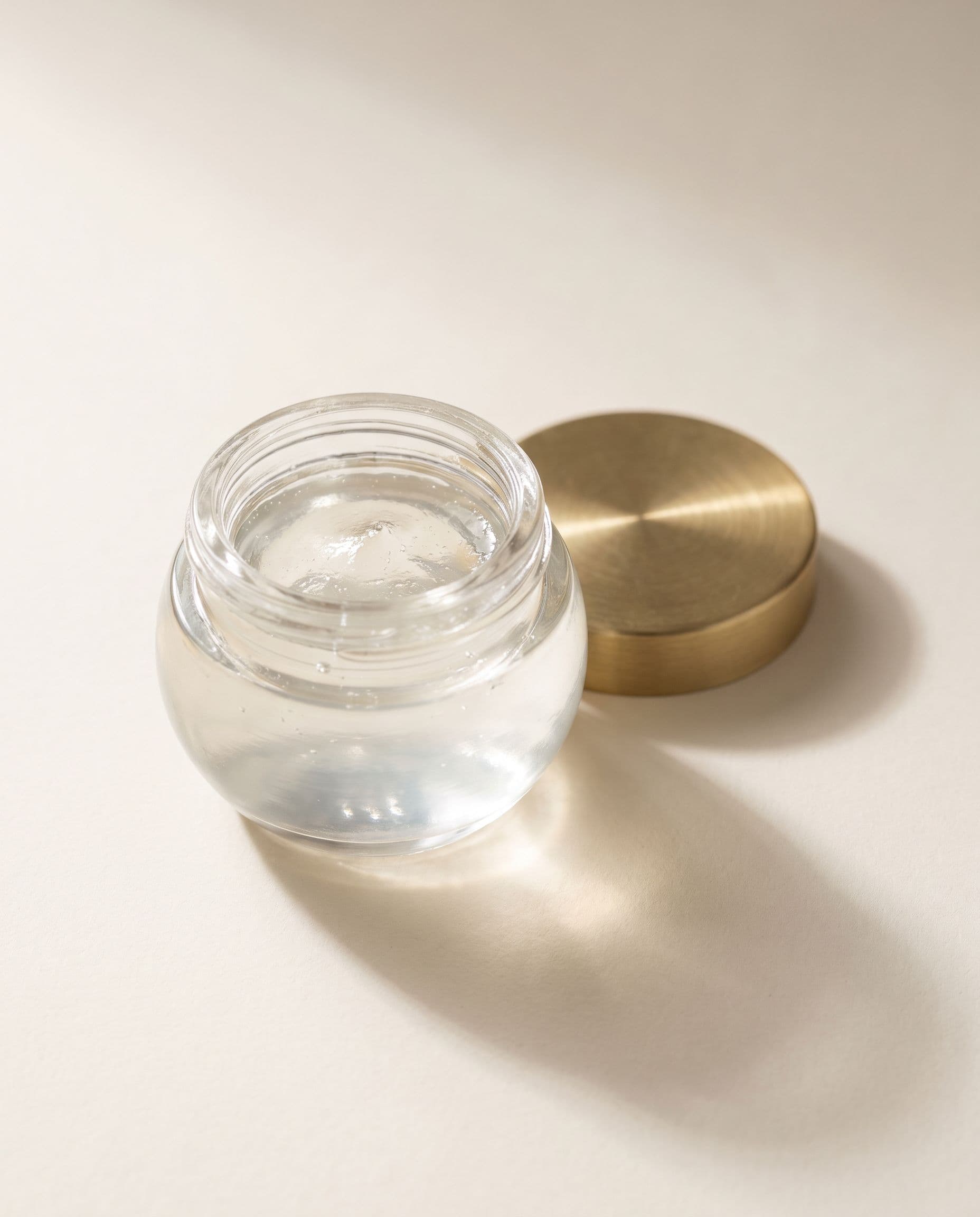
Drop 03/Rosée/Peptide and glycerin
What goes in
Six materials we keep coming back to.
Not a full formula — those change with the month. These are the house materials, the ones a Mirevoir piece is built out of more often than not.
- 01
Squalane
Olive-derived
The carrier under almost everything we make. Weightless, stable, and it moves colour across skin without leaving a film behind.
- 02
Camellia oil
Cold-pressed
High in oleic acid, so it sinks in rather than sitting on top. It is what makes a balm feel worn-in within a minute.
- 03
Candelilla wax
Plant wax
The structure in a stick or a balm. It sets firm at room temperature and softens at body heat — no beeswax, in anything.
- 04
Mineral pigments
Mica-free
Colour ground to a fixed particle size and tested batch by batch. Shine in this house is a finish, never a suspended particle.
- 05
Peptides
Skin range
Used only where the piece stays on the skin long enough to matter, and only at a level we would put on a certificate.
- 06
Glycerin
Vegetable
The oldest humectant in the trade and still the most honest one. It holds water where the formula wants it.
What never does
A shorter list, held to.
These are not preferences we review each season. They are conditions of the brief, and a formula that needs one of them broken does not become a drop.
Never tested on animals — not by us, not by the laboratory, and not for any market that would ask.
No parabens, and no preservative that releases formaldehyde as it works.
No synthetic fragrance in the skin range. Where a drop carries a scent, it is the material itself.
No plastic glitter, in any finish. If a shimmer cannot be made with pigment and oil, we do not make it.
No palm oil, and none of the derivatives it hides behind.
No claim on a carton we could not show you the batch record for.
The packaging
Brass, glass, board.
The box is part of the object, and it outlives the formula inside it. We would rather send you something worth keeping than something engineered to be opened once.
01
Brushed brass
Cases are turned in solid brass and left unlacquered, so they take a patina instead of chipping. Where the format earns it — the lipstick and the pressed pan — the case is built to be refilled and holds any later refill of the same format. A balm, an oil or a liner is not refillable, because forcing it onto those makes a worse object.
02
Glass over plastic
Oils, balms and tints ship in glass. Where a component has to be plastic to stay sterile or safe, we say which part and why on the piece itself rather than quietly leaving it out.
03
Recycled board
Cartons are uncoated recycled board printed in a single ink, folded without glue. No cellophane, no magnets, no foam cut to the shape of the object and thrown away in the first minute.
A few hundred is a decision, not a ceiling.
Every edition in the year is between two hundred and fifty and four hundred pieces. The number is set before a drop opens, and it does not move once the month begins. Thirty thousand pieces would have to be formulated for storage, packed in something lighter, and kept alive long after the month they were made for. Three hundred can be made with the better oil, the brass turned properly, and the list kept short.
It is the constraint that makes the rest of this page possible. A standard is easy to hold when you are making a small number of a single thing, and close to impossible when you are not.
Every list ships with the piece.
This page is the house standard. The full list for a given drop — every material, in order, with the batch it was made in — is printed on the card inside the carton, because the formula belongs to the piece and not to the season.
If you want to read a list before an edition opens, or want the list for a drop that has already closed, ask us. We keep all twelve on file and we send them whole, not summarised.
[email protected]Still deciding
How a drop works, in plain answers.
Refills, shipping, what happens the moment an edition closes, and why there is no restock — the questions we get asked most, answered without ceremony.